All quotations were originally recorded in Haitian Creole and translated into English.
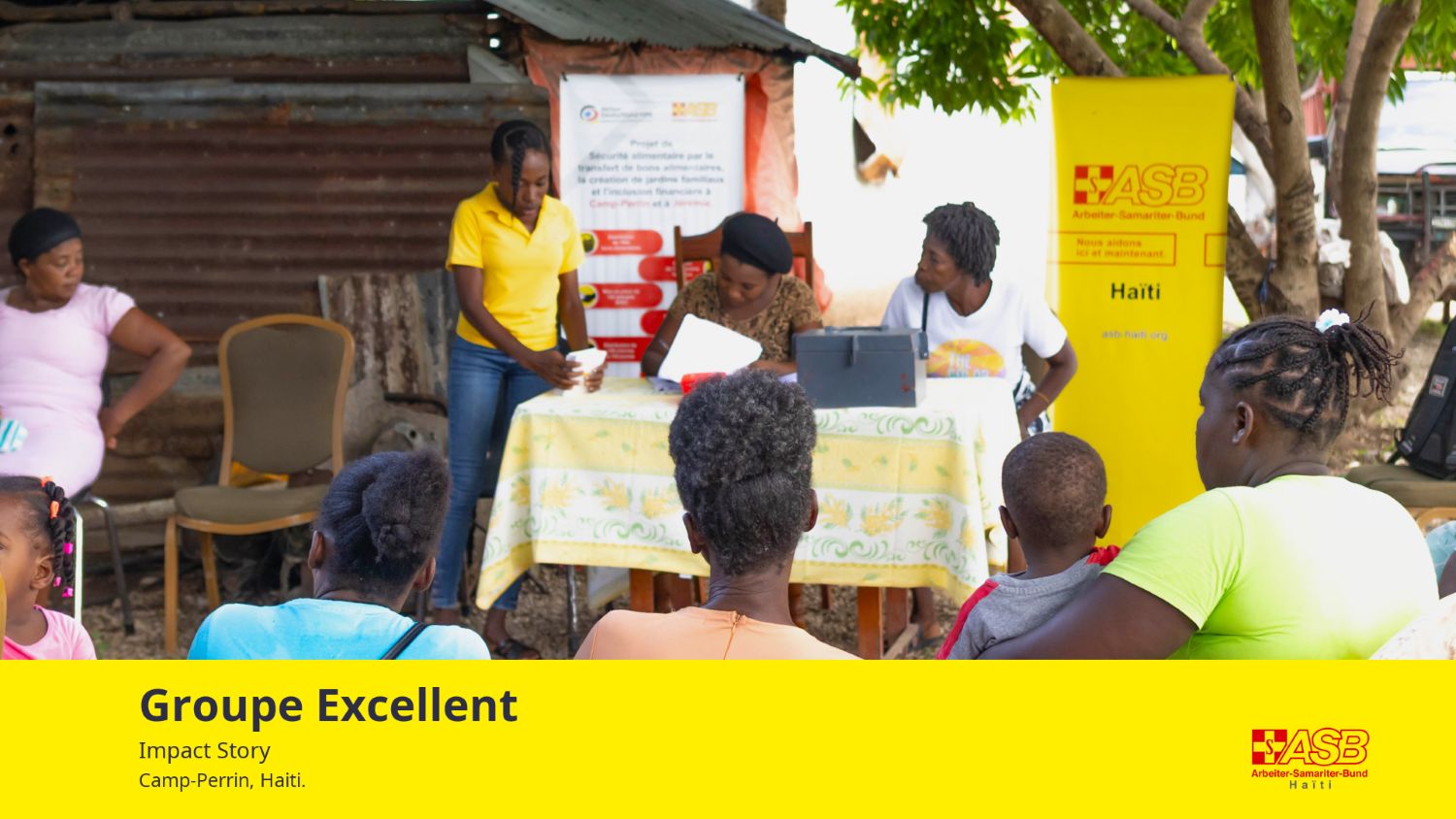
In Trouillard, in the first communal section of Camp-Perrin, the Excellent group is a Village Savings and Loan Association (VSLA), a form of collective savings and lending managed by its members. It brings together 19 people, including 16 women and 3 men. Since February 2026, they have met every week to save, review loan requests and follow the decisions made for their shared fund.
Nerette Genese chairs the group. She is also the second member of the Communal Section Administrative Council (CASEC). She highlights the importance of this fund in the way members organize their activities and make decisions.
Alongside her, Francia Osné, 33 and the mother of two children, divides her time between trade and farming, two activities that are essential to her household.
“Trade and farming help us survive. […] We grow crops so our family can eat, but we cannot consume everything we produce.”
The group was established and is supported as part of the “Food Security through Food Voucher Transfers, Household and Community Gardens and Financial Inclusion in Camp-Perrin and Jérémie, Haiti” project, implemented by Arbeiter-Samariter-Bund (ASB) with support from Aktion Deutschland Hilft (ADH). The training and follow-up support help members make this shared fund a tool for decision-making, savings and lending.
Making Decisions and Saving Together
Before joining a VSLA, several members were already familiar with mutual savings practices. For Nerette Genese, the difference lies in the fact that VSLA members set their own contribution rules and make decisions about their shared fund.
“With the VSLA, it is we ourselves who know our fund and make the decisions. […] We can save according to what we have.”
Members received training in the VSLA methodology, financial education, leadership, gender, elections, committee roles, and the rules governing the fund and the group. The training gives members practical guidance to organize meetings, share responsibilities and monitor each person’s commitments.
The fund therefore does not rest only on the money that passes through it. It also relies on trust, collective rules and regular participation. This framework allows the group to discuss loans, track repayments and sustain its fund over time.
Credit to Support Small Businesses and Gardens
The first loans were issued in March 2026. As of 26 August, 17 of the group’s 19 members had already benefited. Total loans disbursed amounted to 427,200 gourdes, and 223,327 gourdes in repayments had been recorded.
Loans carry a 5% interest rate and are used mainly to develop small businesses and improve gardens. The group also has a solidarity fund, separate from individual loans. This collective reserve may be used, under rules set by members, when someone faces a hardship that calls for support.
For Nerette Genese, the value of the loan is clear in her food provisions business. When she did not have enough cash, she had to buy goods on credit from her supplier, at a higher price.
“When I go to buy goods and I do not have cash, the store sells to me on credit. But when an item costs 2,000 gourdes, I have to pay 2,100 gourdes because I buy on credit. […] Now that I am in the VSLA, I take a loan from the VSLA and have cash. […] I buy at a better price because I no longer buy on credit.”
The loan therefore allows her to buy with cash and avoid the extra cost imposed by buying on credit. The difference stays in her business rather than being added to the cost of her goods.
Francia Osné describes a comparable change in her own activities. She had previous experience of a mutual savings group but joined Excellent after the training provided when the group was launched. She sees it as a way to gradually expand both her business and farming activities.
“Through the VSLA, I can expand my activities and move forward. It also helps me save more.”
Preparing for Greater Independence
The Excellent group is gradually building its independence. During the project, a field agent continues to visit the group approximately every eight days. This support strengthens members’ command of the rules and collective management, without making decisions in their place.
After the project, the group will have to operate independently. If necessary, members may turn to a private service provider (PSP). The agents who support the groups have also been certified as PSPs so that they can provide this type of service.
For Nerette Genese, Excellent’s ambition goes beyond simply keeping its fund going. She wants the group to strengthen its organization and become, in turn, a resource for others in the community.
“What I would like is […] for us to become an organization […] able to help and support other people in need.”
Members also keep their locality’s broader needs in view. Francia Osné names access to safe drinking water, lighting and better roads among Trouillard’s priorities.
“We have water, but it is not safe to drink: clear water does not necessarily mean clean water.”
The Excellent group cannot solve these challenges on its own. It does, however, give members a framework to save according to their means, access credit, strengthen their activities and make decisions together that prepare them for what comes next.