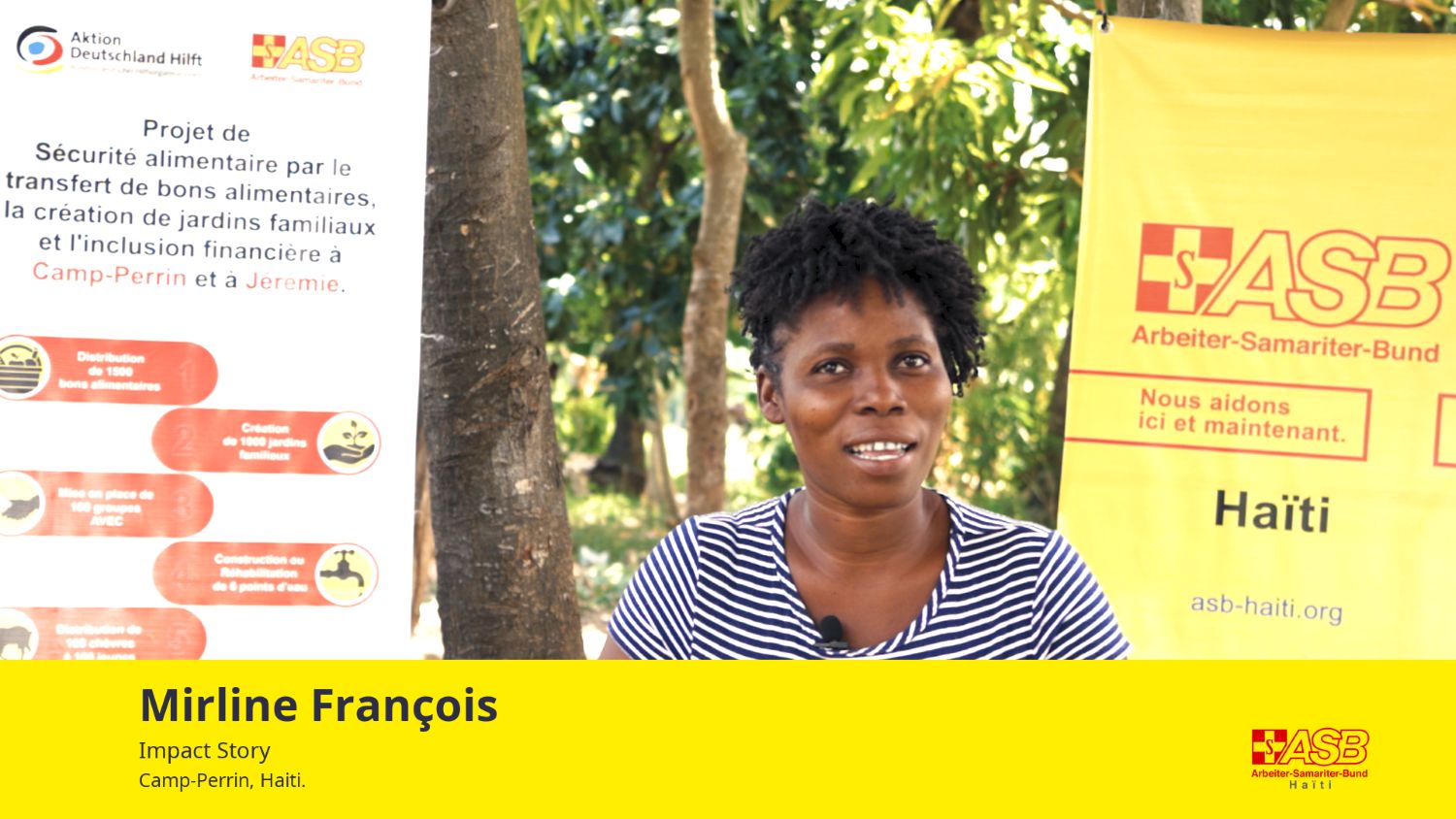
In Rolin, in the commune of Camp-Perrin, 30-year-old Mirline François divides her time between farming and small-scale trade. She sells what she grows in her fields, including leeks, leafy greens, onions, peas and broad beans.
Her experience with goat rearing did not begin with the project. Before receiving a breeding goat through the “food security, livelihoods and water access project implemented by ASB in Camp-Perrin and Jérémie”, she had already tried to raise goats. Her first attempts, however, had not succeeded.
“I had already raised goats, but unfortunately I had not managed to succeed… Before, the goats I had used to die. Today, the one I have is the only one I have.”
The change is therefore not simply about receiving another animal. For Mirline, it is above all the training that came with this support that enabled her to change the way she raises goats.
Learning the care practices she had been missing
Through the goat-rearing component of this project, funded by Aktion Deutschland Hilft (ADH) and implemented by Arbeiter-Samariter-Bund (ASB), 150 young people in Camp-Perrin and Jérémie received a breeding goat. The support did not end with handing over an animal. Training helped participants learn how to feed goats properly, protect them from sun and rain, monitor their health and seek veterinary care when needed.
For Mirline, this transfer of knowledge gave her activity a new meaning. She understood that goat rearing is not only about owning a goat, but about being able to care for it every day.
“During the training, they explained what to do, how to manage the animal, give it veterinary care when it needs it, feed it, keep it from too much sun and protect it from rain.”
The training has helped her understand what had been missing before. Previously, she did not provide care at the right time, did not know how to seek veterinary treatment, and did not yet know all the practices she now applies.
“Before, I did not know how to care for them at the right time and I did not give them veterinary care… I tie her up, bring her inside, but I did not yet know all the practices I use with them today.”
This change became visible within a few months. Seven months after receiving her goat, Mirline saw the animal give birth, the kid grow, and the mother make progress as well.
“I have achieved many results because the goat gave birth, the kid has already grown, and the mother is progressing too.”
A first result that opens new possibilities
This first result confirms for Mirline that she can build a goat-rearing livelihood on stronger foundations. Her ambition remains gradual: to continue raising goats, keep the female kid so it can grow and reproduce in turn, then buy more animals when she has the means.
“I will continue raising goats… Yes, I plan to buy other animals.”
Between farming, trade and livestock rearing, she is working to strengthen her livelihood step by step. She describes the project’s contribution in terms of both skills and material support. She also hopes that other young people in her community can receive a similar opportunity.
“They are teaching me to save and helping me grow… May they continue, so that other young people can benefit and receive support tomorrow, God willing.”
Through Mirline François’s experience, this intervention shows that a productive asset reaches its full potential when it is accompanied by training. The goat she received is the beginning of her project, but the practices she has learned now give her the opportunity to develop it with greater confidence and continuity.
This article is part of project HTI2502: Food security in Camp-Perrin and Jérémie.