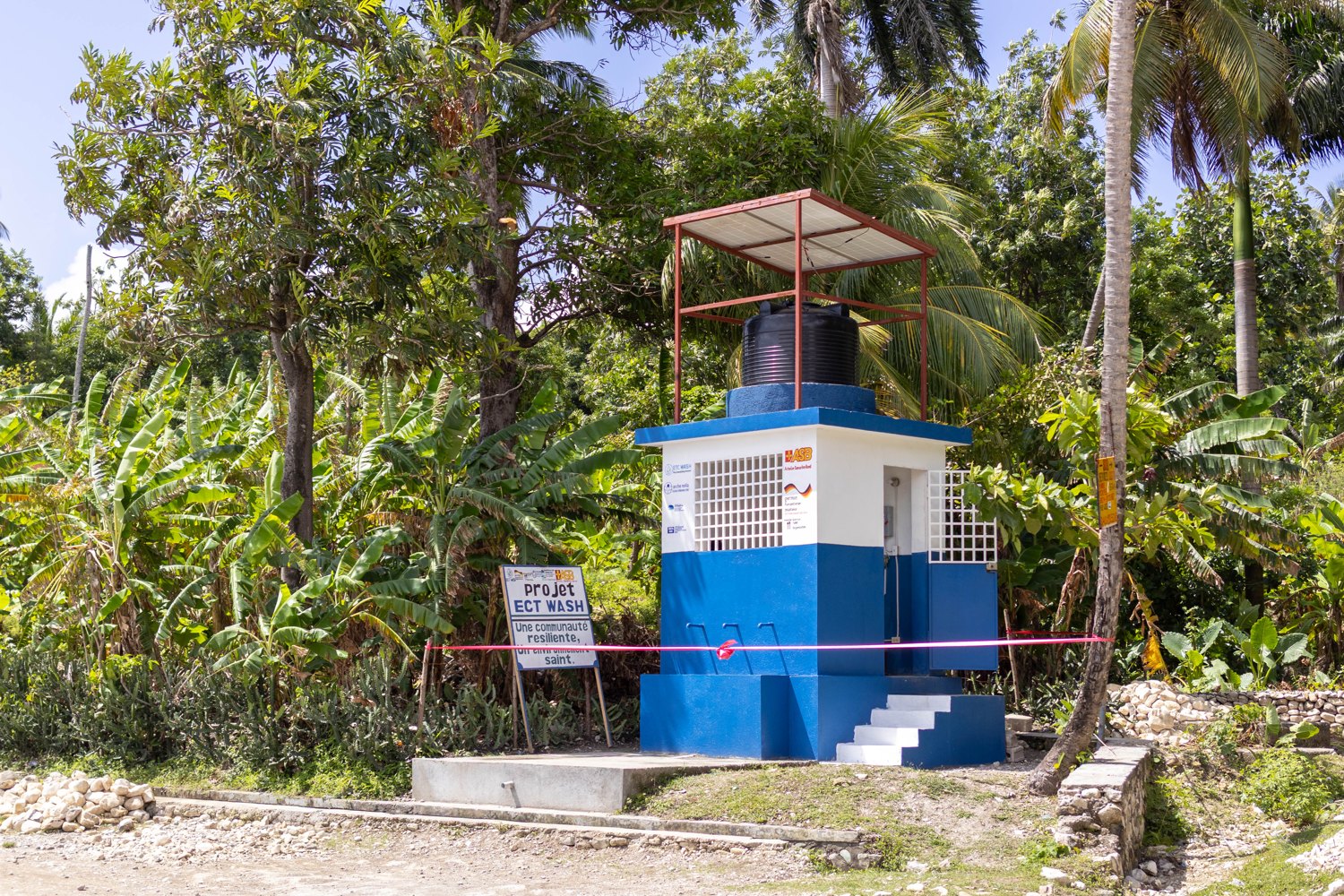
In the communes of Saint-Jean-du-Sud and Corail, in the Sud and Grand’Anse departments, access to safe drinking water remains difficult, worsened by the aftermath of Hurricane Matthew in 2016 and the 2021 earthquake. Infrastructure is damaged and water points are often more than five kilometres away. In this context, the Arbeiter-Samariter-Bund, with the support of the German Federal Foreign Office (GFFO) and in partnership with Arche noVa and the German Toilet Organisation, is implementing the ECT WASH project to strengthen local capacities in water, sanitation and hygiene.
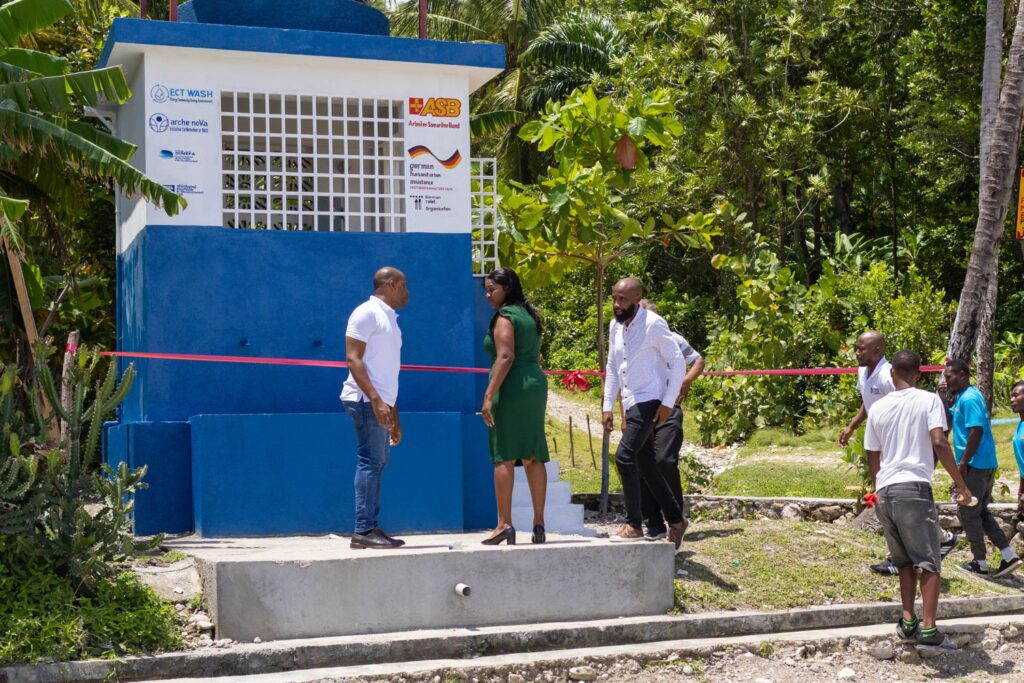
Three sites, three realities
Before construction began, project teams carried out assessments together with the TEPACs, local authorities and communities, to identify the challenges of drinking-water access and define suitable solutions.
In the first communal section of Saint-Jean-du-Sud, known as Tapion, many families relied on the Kay Madame Octel spring. Located by the sea, it had long been one of the main water points in the area. Yet the water was drawn directly, without treatment. Some residents had to walk up to five kilometres to reach better-quality water.
In the second communal section of Debouchette, the situation in Haut-Cheval was concerning after the vandalism of a water system comprising a borehole, a solar pump and a reservoir, now out of service.
In the commune of Corail, in the first communal section of Duquillon, consultations with communities also confirmed the need to strengthen access to drinking water. With more than 14,000 inhabitants, this section is among the most populated of the areas covered by the project.
Faced with these realities, the challenge was not only to build new infrastructure: it was essential to offer durable solutions, beyond construction alone.
[IMAGE : C:\Users\WismyFontin\OneDrive – Arbeiter-Samariter-Bund Deutschland e.V\COMMUNICATION\01_PROJECTS\ECT-WASH\03_COMMUNICATION\02_MEDIA\Graphics\2026-06_stations-potabilisation\ECTWASH_2026-06_stations_F11 – June 20, 2026 at 14.18.04.png — alt: key figures of the ECT WASH project (457 households, 2,300 people, 3 stations).]
Tapion: a first commissioning
The Tapion station, inaugurated in April 2026, serves about 457 households, nearly 2,300 people. Water is captured at a spring, treated by filtration and chlorination, then distributed through a neighbourhood kiosk. The system is powered by solar panels, reducing dependence on fossil fuels and long-term operating costs.
“People always say water is life, but we also know there is water you drink that can put you underground. That is why we brought this treatment station to the community. Besides the kiosk, we installed a power system and a water treatment system.”
Kens Valbrun, WASH engineer, ECT WASH project (originally spoken in Haitian Creole)
The Haut-Cheval and Duquillon stations are in the final stages of construction and will soon be handed over to their communities.
Local governance and lasting service
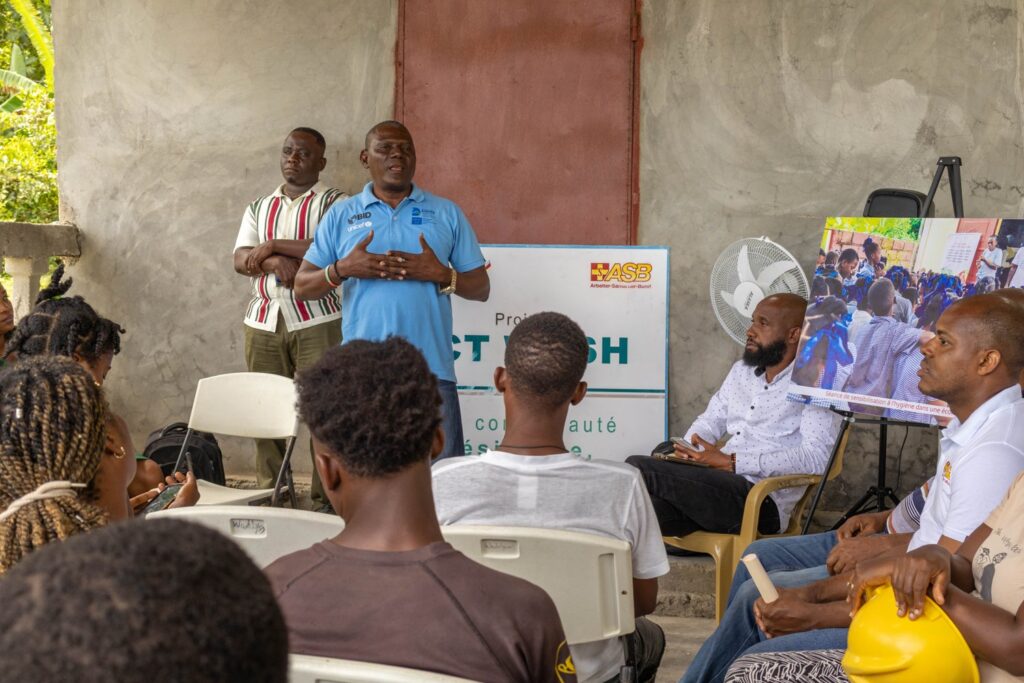
The durability of a water service depends on the technical quality of the infrastructure and the community’s ability to manage it. The CASECs, ASECs, TEPACs and residents take part in every stage of the project, and the use of local labour during construction fosters ownership of the infrastructure.
A three-member management committee was formed in Tapion before commissioning, supported by DINEPA and OREPA-Sud, to receive training on equipment maintenance, the solar system and water treatment. A community contribution mechanism was set up to fund future maintenance, and similar arrangements will be established in Haut-Cheval and Duquillon.
“Water is life, but we must not waste it […] Just as it is our right to have water to drink, it is also our duty to protect the infrastructure so it can last as long as possible.”
Yves Antoine Alexie, TEPAC of Saint-Jean-du-Sud (originally spoken in Haitian Creole)
“It is not only the committee members who manage the water, it is all of us together.”
A member of the Tapion station management committee
“A project cannot succeed without the involvement of those it serves.”
Marie Christa Clotaire, mayor of Saint-Jean-du-Sud
Through its three water treatment stations, the ECT WASH project aims to improve water supply in the communes of Saint-Jean-du-Sud and Corail, strengthening resource management for several thousand families. The goal is to prevent waterborne diseases and build resilience to climate shocks.