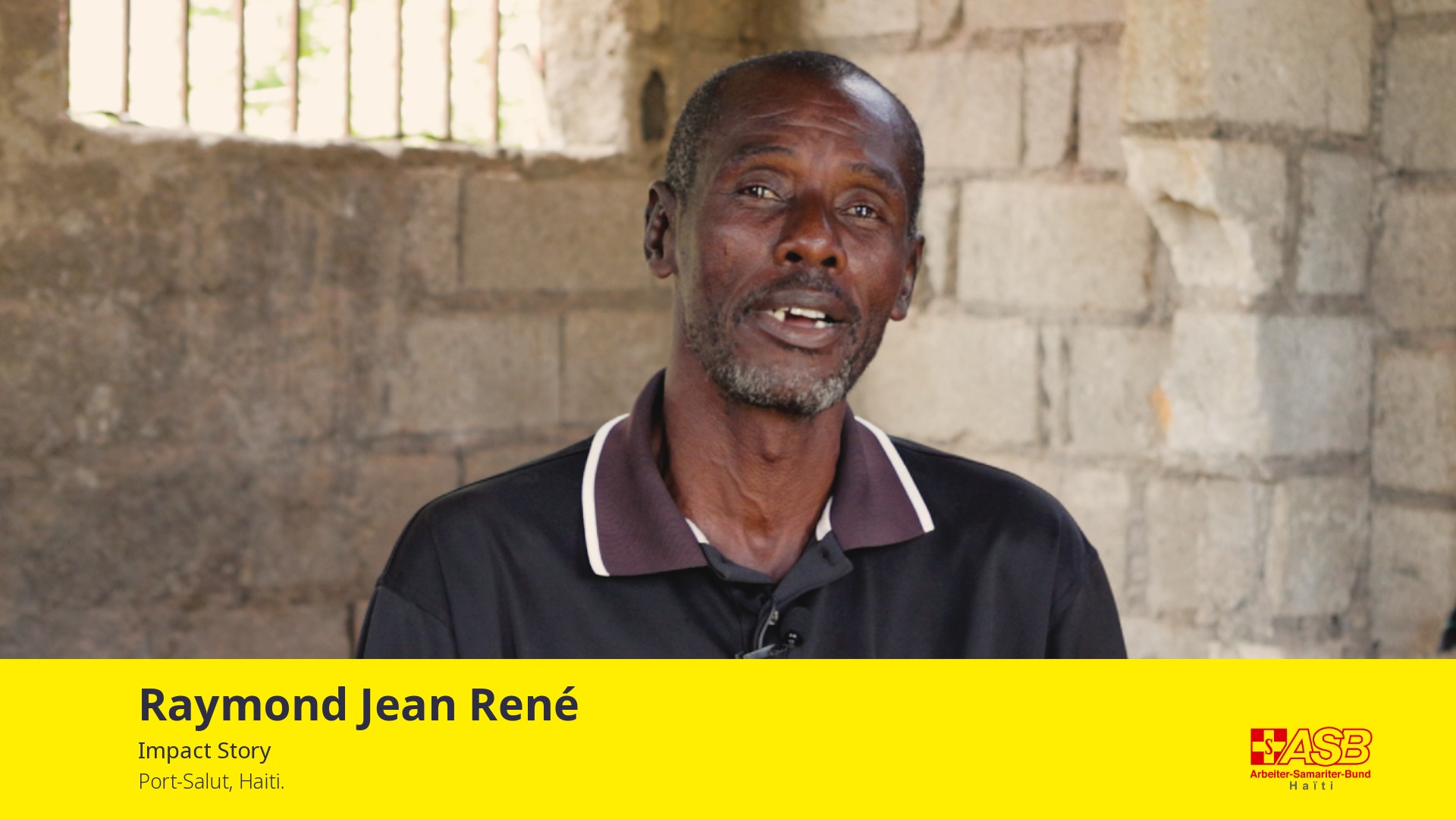
At 65 years old, Raymond Jean René is now trying to rebuild his life in Port-Salut after leaving Port-au-Prince in a context marked by insecurity and the gradual collapse of his economic activities. Father of six children, five girls and a boy, he previously lived in the capital where he worked as a kanbiz (stockbroker).
For several years, this activity had enabled him to provide for his family, pay for his children’s schooling and maintain a certain economic stability.
“M t ap travay trè byen kòm kanbiz. Mwen te konn chanje dola, aktivite yo t ap mache trè byen… Lekòl timoun yo på t konn difisil pou peye. (I worked very well as a stockbroker. I was exchanging dollars, the activities worked very well. It was not difficult for me to pay for the children’s schooling.)
In addition to his business activities, Raymond was also involved in the organization of cultural activities in his native town of Port-Salut, where he participated in the promotion of Haitian groups and artists.
Life turned upside down by insecurity
But with the deterioration of the security situation in Port-au-Prince, his life has gradually been turned upside down. Violence by armed groups has destroyed the conditions that allowed him to work and support his family.
“Bandi se detwi sa w genyen w ap fè. Kèlkeswa sa w ap fè, se pou yo benefisye ladan l. Epi mete w a zewo. (Armed groups destroy everything you own. No matter what you do, they want to enjoy it, and then they bring you back to zero.)
Faced with this situation, Raymond Jean René finally left Port-au-Prince to return to Port-Salut. He describes this departure as an escape, carried out in extremely difficult conditions.
“Mwen soti Pòtoprens, bandi mete m deyò, mwen vin isit. Mwen vin konsa, se kòmsi mwen sove. (I left Port-au-Prince because the bandits forced me to leave. I came here as someone who ran away.)
Even his return to his home community was without resources.
“Menm pou m antre Port-Salut, se CASEC la ki te ede peye transpò a pou mwen. Mwen pa t menm gen senk goud nan pòch mwen.”
(Even to get back to Port-Salut, it was the CASEC that helped pay for my transport. I didn’t even have five water bottles in my pocket.)
Continuing to support your children despite difficulties
After returning to Port-Salut, Raymond found himself without stable activity and partially dependent on his family to survive. Despite his age, however, he remains the main breadwinner for his children, many of whom still live in Port-au-Prince.
“Lè se papa ou ye, ou toujou ap panse ak timoun yo.” (When you’re a father, you always think about your children.)
He explains that economic difficulties made some essential expenses impossible to cover, including school fees.
“Menm kòb fèy egzamen timoun yo mwen pa t kapab peye. Timoun yo t ap rele m, yo bezwen fèy pou yo ka konpoze. (I couldn’t even pay the exam sheets. The children called me because they needed the fee to take their exams.)
To survive, he is now trying to practice small agricultural activities, including vetiver farming, without regaining the stability he once knew.
“Pafwa mwen rete lakay, mwen chèche yon bagay pou m plante. Mwen plants vetiver sitou… Men sa pa yon aktivite ki estab ase pou viv. (Sometimes I stay at home and look for something to plant. I mainly grow vetiver… but it is not a stable enough activity to live on.)
Assistance received in a critical period
In this context, Raymond Jean René received financial assistance as part of the emergency response project implemented by ASB in the departments of Sud and Grand’Anse after the passage of Hurricane Melissa.
The project combined several forms of assistance, including food and hygiene kit distributions, cash transfers, water treatment activities and community awareness-raising.
For Raymond, this help came at a particularly critical time, when he no longer had the resources to meet his children’s priority needs.
“Timoun yo te bezwen ale nan egzamen, epi se te sèlman 2000 goud ki te bloke yo. Lè kòb la rive, mwen te kapab voye yo al konpoze.” (The children had to go to the exams, and only 2000 gourdes were missing. When the money arrived, I was able to send it to them.)
The assistance has temporarily relieved the economic pressure on the household.
“Apre Bondye, se ASB ki fè timoun yo pran yon souf.” (After God, it was ASB who allowed the children to breathe a little.)
Raymond also highlights how quickly this assistance was used to meet his family’s urgent needs.
“Kòb ASB la rive nan men gòch, li soti nan men dwat. Men sèvis li te dwe rann lan, li rann li.” (The money from ASB arrived in the left hand and left in the right hand. But he has rendered the service he was supposed to render.)
Keeping hope alive despite uncertainties
Even today, Raymond Jean René is still confronted with many difficulties. Between the loss of his business, the consequences of insecurity and the fragility of local economic opportunities, he is gradually trying to rebuild his life while continuing to support his children.
Despite everything, he remains hopeful of one day finding some stability.
“Nou espere yon jou lavi a ap chanje pou nou. ” (We hope that one day life will change for us.)
Through the journey of Raymond Jean René, this intervention highlights the cumulative effects of the security, economic and climate crises on Haitian families. It also reiterates the importance of rapid and targeted assistance to support the most vulnerable households in times of high instability, while highlighting the persistent challenges related to sustainable livelihood recovery.