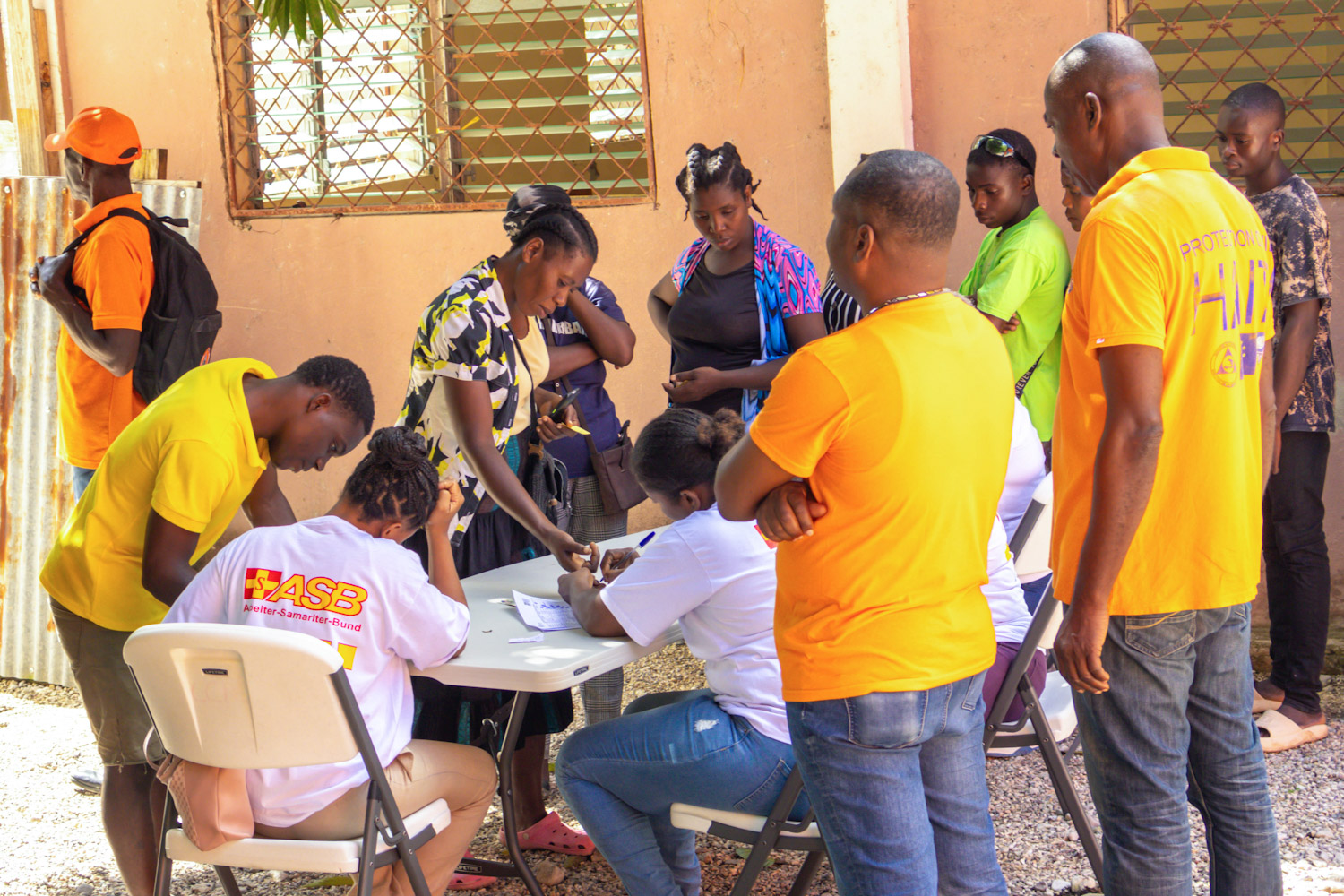
Following the passage of Hurricane Melissa in October 2025, the South and Grand’Anse were hit hard. Floods, damaged homes, disrupted infrastructure, in a few hours, the living conditions of thousands of families have been turned upside down. In the communes of Port-Salut, Camp-Perrin and Jérémie, access to drinking water, food and basic resources has come to an abrupt halt.
In this context, the Arbeiter-Samariter-Bund (ASB) has rolled out the 6-month project entitled “Emergency Response to Hurricane Melissa” to meet the most immediate needs and limit health risks, while supporting the first stages of the recovery of affected households.
Funded by ASB and Aktion Deutschland Hilft (ADH), this urgent intervention has made it possible to provide direct assistance to several thousand people, despite significant logistical constraints and fragile infrastructure.
A response adapted to immediate and multiple needs
In the days following the disaster, the effects quickly accumulated. Access to safe drinking water has become limited, increasing the risk of waterborne diseases. Food supplies have been lost or made inaccessible. Hygiene conditions have deteriorated in the areas of displacement.
Faced with this situation, the intervention was designed to act simultaneously on several essential needs. It was structured around four complementary axes:
- Access to drinking water,
- Emergency food assistance,
- Support for hygiene and dignity, and
- Financial assistance to the most vulnerable households, complemented by awareness-raising actions on risk management.
- Access to safe drinking water: a vital priority
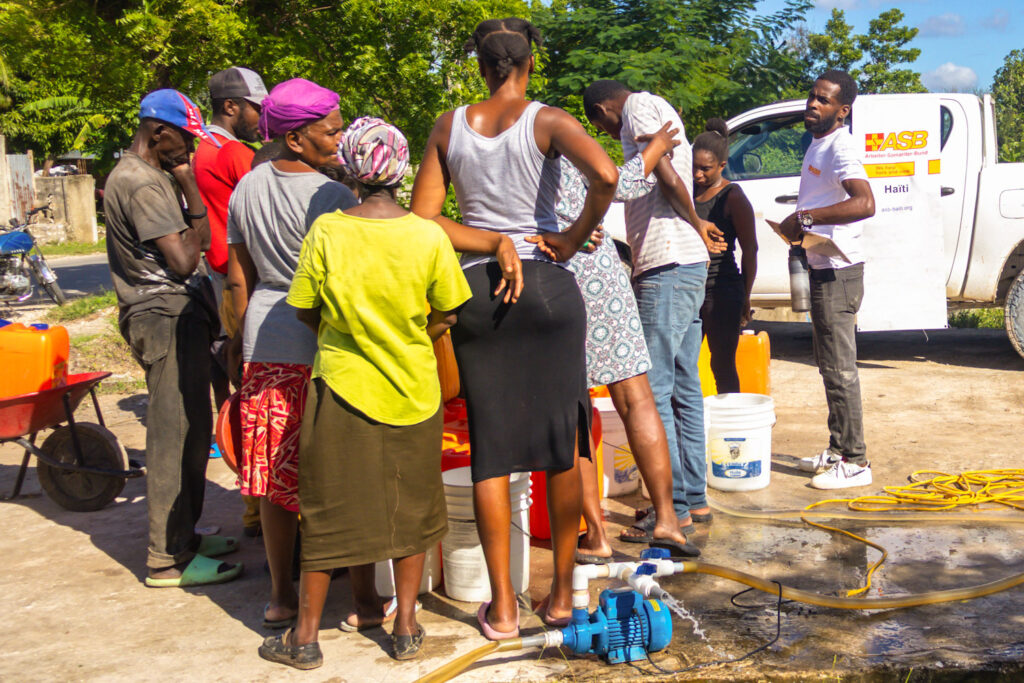
Water infrastructure was heavily damaged in several municipalities by the hurricane. In Camp-Perrin, sections of the distribution network were swept away by the water, interrupting the supply of drinking water and plunging part of the population into a situation of critical need. In some localities in Port-Salut, households have been forced to consume untreated water, increasing the risk of waterborne diseases.
In response, ASB implemented a water treatment and distribution system using SkyHydrant filtration systems to ensure immediate access to safe water in the most affected areas.
In total, nearly 100,000 liters of drinking water have been treated and distributed, providing more than 4,000 people with access to safe drinking water. This intervention helped to limit health risks in a context where the available alternatives were insufficient or unsafe.
In addition to the volumes distributed, the action made it possible to respond to an immediate disruption in service, by ensuring temporary access to drinking water pending the rehabilitation of local infrastructure.
- Food assistance: meeting immediate needs
In several areas, farmers lost maize, beans, and yam crops, while fishers lost their boats and traders saw their goods washed away or damaged. The partial or complete destruction of homes also displaced many families, increasing their exposure to food insecurity.
In this context, many families were left without resources or food reserves in the days following the disaster. As one farmer in Camp-Perrin points out, “everything I had to live on is gone,” illustrating the scale of the losses suffered by households dependent on agriculture and informal activities.
To meet these immediate needs, ASB has distributed 300 food kits to affected and displaced households in the targeted areas. This assistance helped cover basic nutritional needs in the post-hurricane period.
Priority was given to the most vulnerable households, including female-headed households, families with children, and older people, whose capacity to cope with the shock was especially limited.
- Hygiene and dignity: preventing health risks
In the aftermath of Hurricane Melissa, many households were forced to take refuge in temporary shelters or partially damaged homes, often overcrowded and exposed to moisture. Under these conditions, access to adequate sanitation facilities has become limited, increasing the risk of diseases, particularly waterborne and cutaneous.
In some areas, the lack of treated water and difficulties in accessing hygiene products further aggravated the situation, especially for women and adolescent girls. The maintenance of minimum hygiene conditions has thus become an essential issue to preserve the health and dignity of the affected populations.
In response, the project has enabled the distribution of 300 hygiene kits to women and adolescent girls living in the most affected areas, particularly in contexts of displacement or high vulnerability.
These kits, including essential personal care and menstrual hygiene items, have helped reduce health risks and maintain more dignified living conditions in a precarious environment.
- Financial assistance: supporting household autonomy
In a context where many households had lost their sources of income, productive assets or commercial stocks, in-kind assistance was not enough to cover needs. Losses of livestock, crops, goods or fishing equipment have severely reduced the ability of families to meet essential expenses.
The project has set up a cash transfer mechanism targeting the most vulnerable households to address this need.
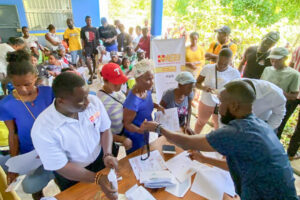
A total of 150 households received direct financial assistance of 12,000 HTG each. The beneficiaries were identified through a structured process in coordination with the local authorities of Port-Salut. Selection criteria included female-headed households, families with young children, the elderly, people with disabilities, as well as displaced households or households with major losses.
This approach allowed beneficiaries to prioritize their expenses according to their real needs, whether it was procuring food, covering health costs, supporting children’s schooling, or undertaking small repairs. For some households, this support has been an essential lever for dealing with urgent expenses in the context of severe constraints.
By providing this flexibility, cash assistance has helped to strengthen households’ adaptive capacity and preserve their dignity, allowing them to make choices based on their priorities.
- Awareness and preparedness: building local resilience
In addition to emergency assistance, the project integrated awareness-raising activities on disaster risk reduction and climate change adaptation. In particularly exposed areas, these actions aimed to strengthen the capacity of communities to anticipate and react to hazards.
As many as 3,000 people were reached through mobile campaigns, community sessions and outreach actions. The messages were accompanied by adapted visual aids and short scripts relayed by megaphone, making it possible to effectively reach populations, including in hard-to-reach areas.
The materials focused on the main risks identified in the areas of intervention, cyclones, floods, landslides, earthquakes and marine submersions, as well as on the behaviors to adopt before, during and after an event. This approach has made it possible to transmit simple, practical instructions that are immediately applicable to households.
In a context marked by the recurrence of shocks and the vulnerability of populations, these activities contribute to gradually strengthening the capacity of communities to prepare for and mitigate risks and protect their livelihoods.
The faces of recovery: between immediate losses and gradual recovery
Beyond the operational results, the emergency response has supported households facing a sudden disruption in their living conditions. The testimonies collected in the intervention areas highlight the extent of the losses, but also the concrete effects of the assistance on the gradual stabilization of living conditions.
In the coastal areas of Port-Salut, Edèle Laurore, a beneficiary affected by the passage of the hurricane, describes a situation of immediate loss. She evokes the disappearance of her animals, the partial destruction of her home and the displacement of her family to a shelter:
“Hurricane Melissa has… li pa touye pitit mwen, li pa touye marim, men li fèm anpil tò. (The hurricane didn’t kill my children or my husband, but it did do us a lot of harm.)
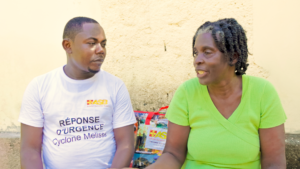
Privée de ressources, elle témoigne des difficultés à nourrir sa famille dans les jours suivants :
Deprived of resources, she testifies to the difficulties of feeding her family in the following days:
“We had nothing at all… We were looking for a banana to save the children’s lives. “We didn’t have anything at all. We were looking for some bananas to save the lives of the children.)
After receiving the assistance, she clearly expresses the impact of the assistance on the survival of her household:
“You came to save my life, my children’s life, my wife’s life.” (It saved my life, my children’s lives, and my husband’s lives.)
In rural parts of Port-Salut, agricultural losses had immediate and lasting effects. Farmer Joseph Pierre said he lost nearly all his crops, especially maize and peas:
“Tout sa m te genyen pou m viv, tout pèdi.” (Everything I had to live on is lost.)
In this context, access to resources, even limited ones, becomes essential to cope with daily life. The assistance received is perceived as concrete support in a period where alternatives remain very limited.
For other households, the crisis has resulted in an inability to meet priority spending. Raymond Jean René, a father, explains that he was unable to ensure his children’s schooling:
“Menm kòb fèy egzamen, m pa t ka peye.” (I couldn’t even pay the exam fee.)
Following the support received, he underlines the direct effect of this aid on his ability to meet these needs:
“Well, ASB fè m peye l… m di Bondye mèsi, e m di nou mèsi tou. (Thanks to ASB, I was able to pay… I thank God and I thank you too.)
Taken together, these testimonies illustrate the same dynamic: Hurricane Melissa led to an immediate disruption of livelihoods, plunging households into a survival situation. The assistance provided has made it possible to meet basic needs and stabilize the immediate living conditions of part of the affected population. However, the resumption of economic activities and the return to sustainable living conditions remain gradual and dependent on structural factors such as access to resources, infrastructure and local opportunities.
Conclusion: an appropriate response to persistent vulnerability
At the end of this intervention, concrete results were obtained in a context marked by a rapid deterioration of living conditions following the passage of Hurricane Melissa. Access to clean water, food assistance, hygiene kits and financial support has helped meet the basic needs of hundreds of affected people in the project’s target locations. At the same time, awareness-raising activities have contributed to strengthening the capacities of communities to better understand and anticipate risks.
The outlook for the future is based on clear operational priorities:
- Support the gradual rebuilding of livelihoods, through approaches combining financial support, economic recovery and targeted support for vulnerable households.
- Sustainably strengthens access to safe drinking water and essential services, by supporting the rehabilitation of local infrastructure and community capacity.
- Consolidate awareness-raising actions by including them in local risk preparedness systems, to ensure their continuity beyond the emergency.
- Improve the link between emergency response and recovery, through progressive interventions adapted to the realities on the ground.
Three cross-cutting lessons emerge from this intervention:
- The importance of a fast and flexible response, able to adapt to changing needs.
- The relevance of multisectoral approaches to address vital needs and mitigate secondary risks.
- The central role of local mechanisms, both in targeting and in the implementation of actions.
Ultimately, this intervention has made it possible to stabilize living conditions in the most critical phases, while laying the foundations for a gradual recovery. However, the challenges remain significant, and the consolidation of gains will depend on the continuation of adapted actions, anchored in local realities and oriented towards the sustainable reconstruction of livelihoods.