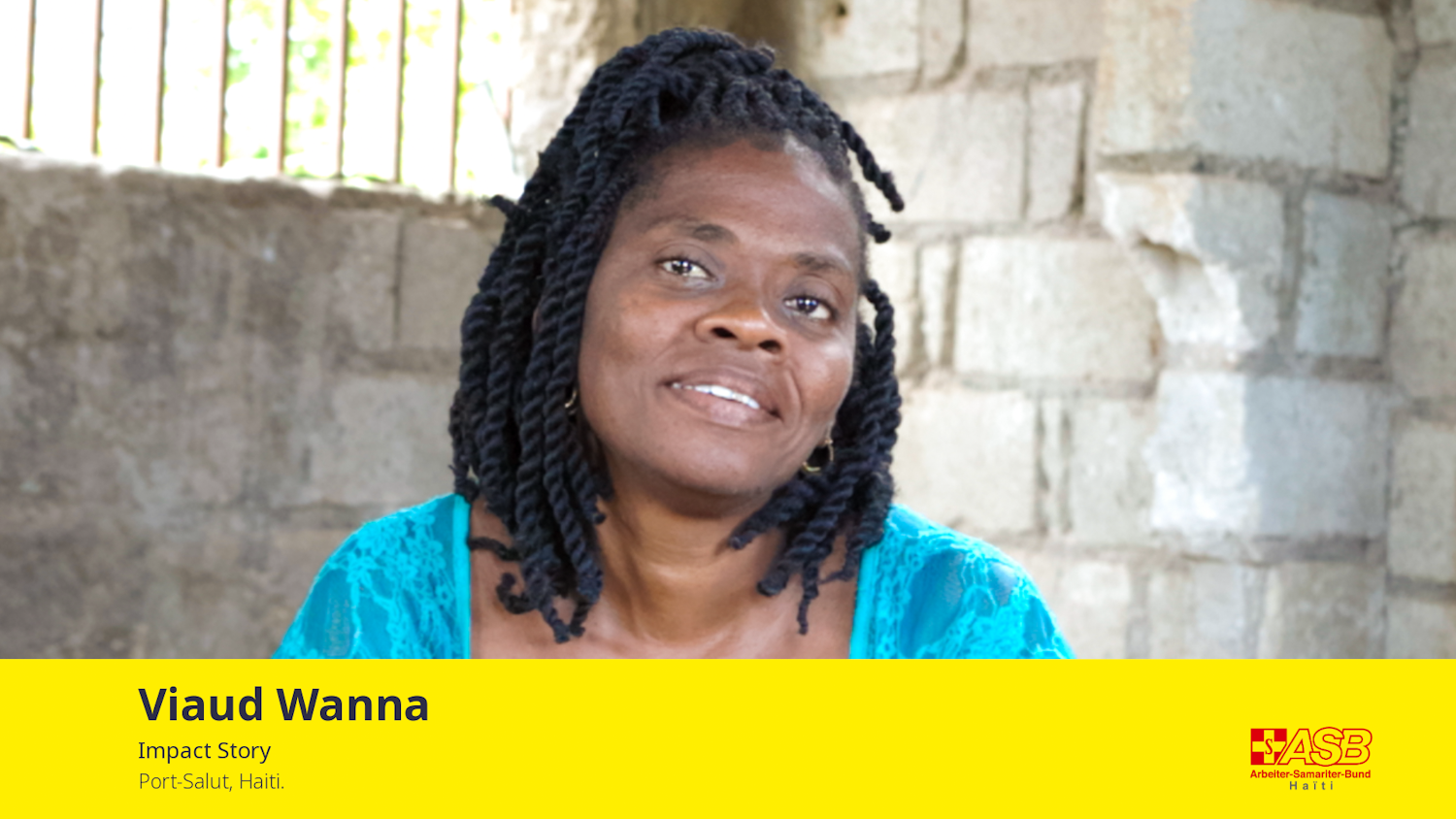
In Port-Salut, in the South Department, Viaud continues to struggle every day to keep his home afloat through small business activities. A mother of three, she is one of many women who depend on informal trade and community solidarity mechanisms to support their families in an economic context that has become particularly difficult.
Like many women in her community, she participates in a mutual organized within a local women’s group. These community-based systems allow women to take small loans to start or maintain modest income-generating activities.
“Se manman w ye, ou pa ka rete chita san fè anyen. Nou gen ti gwoup nou ki òganize mityèl. Ak mityèl sa, nou prete kòb pou fè komès pou fè fwaye a viv. (When you’re a mother, you can’t sit idly by. We have our small groups organized in mutuals. Through this, we borrow money to trade and support the household.)
But despite these solidarity mechanisms, incomes remain extremely fragile. The profits generated by small business activities are rarely sufficient to cover the needs of the household or to rebuild the capital needed to continue working sustainably.
An already fragile economy aggravated by the crisis
After Hurricane Melissa, economic hardship has become even more pronounced. Between the drop in purchasing power, the losses suffered by families and the difficulties of supply, small shopkeepers like Viaud have seen their activities slow down sharply.
“Ou gendwa prete kòb la pou w achte, men lè pou re-achte ankò ou gendwa pa jwenn kòb la. Paske anpil sa w bezwen yo, se ladan l yo soti. You
can borrow money to buy goods, but when it comes time to buy again, you don’t have the money anymore. Because many household needs are covered with that same money.)
She explains that women must constantly arbitrate between immediate family expenses and the survival of their economic activities.
“Lè w fin retire ladan l pou bezwen kay la, ou pa jwenn pou mete ankò.” (When you use this money for the needs of the house, you can’t find anything to reinvest.)
In this context, households’ coping capacities became even more limited after the disaster.
Assistance received in a critical period
As part of the emergency response project implemented by ASB in the departments of Sud and Grand’Anse, Viaud has benefited from financial assistance and a food kit for households affected by Hurricane Melissa.
The project combined several forms of assistance, including food and hygiene kit distributions, cash transfers, water treatment activities and community awareness-raising.
For Viaud, this aid came at a particularly important time, as she was looking for ways to maintain her economic activities during the Easter holiday season.
“Lè kach la rive a, se pandan nou t ap panse pou fèt la. Mwayen an potko ka kore sa nou bezwen pou nou al bwase lari a.” (The financial aid came at a time when we were looking for how to organize ourselves for the holidays. We did not yet have the necessary means to resume our activities.)
She explains that this assistance provided immediate relief to the household and temporarily supported its business activities.
“Lè kach la vin vini, li te kore yon ti bwa dèyè bannann nan.” (When the money arrived, it came to strengthen our situation a little.)
Food assistance also made it possible to temporarily reduce some household expenses during a period of very limited resources.
“Nou pa ka di li piti paske nou pa t genyen anyen.” (We can’t say it was little, because we had nothing.)
Strengthening women’s organizations to support recovery
Beyond immediate assistance, Viaud testifies highlights the central role of women’s community-based organizations in local economic resilience mechanisms.
According to her, these structures already play an essential role in supporting women traders, but they themselves lack the means to support their members in the long term.
“Gen anpil ti machann nan lari a se òganizasyon ki mete yo deyò. Si yo te jwenn ranfòsman, sa t ap ede manman yo plis. (Many small traders on the streets are supported by organizations. If these organizations received more reinforcement, it would help mothers even more.)
In particular, she advocates for increased support for community mutual insurance systems that allow women to maintain a certain economic activity despite crises.
“Si yo ta ranfòse òganizasyon sa yo, ranfòse mityèl ki anndan yo, paske se a lèd yo nou rive fonksyone, li t ap mye.” (If these organizations and their mutuals were strengthened, it would improve our situation a lot, because it is thanks to them that we are able to function.)
Through Viaud Wanna’s journey, this intervention illustrates the importance of community solidarity mechanisms in the survival strategies of vulnerable households in Haiti. His testimony also reminds us that, beyond emergency assistance, the sustainable recovery of communities also involves the gradual strengthening of local structures that already support the populations daily.